Eight months later, GNS signed another family death certificate 500 miles south in Liverpool.
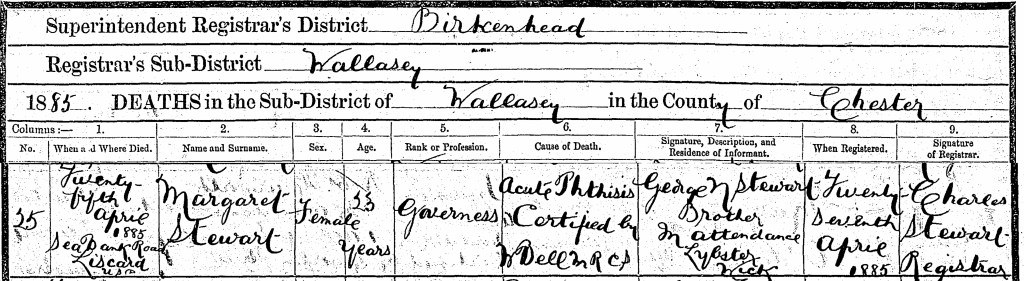
In this register, a blunt pen nib widened the handwritten letters, loops straying outside the box lines.
The brief entries were dated two days after the event, when George N Stewart, the brother in attendance from Lybster, reported the details.
His middle sister Margaret, born after him, had moved to Wallasey, a suburb, where she worked as a governess, an educated woman of sterling character hired by a wealthy family to tutor their children at home. Although a live-in like the maid, she had specific day time duties as teacher, supposedly not on call past the children’s bed time.
How did she get to Liverpool, the sea port associated with the triangle trade, shipping goods to Africa to buy slaves for the Caribbean and United States, bringing back cotton, sugar and tobacco ?
Where did she get the training, how paid for it ? Did GNS fund her studies ? The answers must be searched elsewhere than the official registers.
Like her older brother, and their parents, she left the village to pursue another path. How did she find this employment so far from home ?
As ambitious postgraduate in search of permanent posting, GNS had taken several part time openings available in his profession. He traveled by train from London to Oxford to Manchester, up the Mersey River from Liverpool. In that age of steam trains and schedules made famous in Sherlock Holmes mysteries, he had a weekly rotation of medical school lectures, Lewes fellowship, practice and qualifications.
Did he meet someone who wanted to hire a governess ?
On the sloppy form, cause of death was deciphered : phthisis. Not sure of the spelling or unreliable writer, I looked it up. In those times, the name might have been an euphemism because most people knew tuberculosis as a devastating lung disease spreading among the poor.
It ravaged people living in crowded housing, slums where most working people and countryside migrants managed the low rent. Low wages meant money was short for food, clothing, shoes and staples. Tiredness and anxiety from 14 hour shifts further lowered resistance. In damp cold weather when people stayed inside, disease found anyone susceptible. Lack of clean water, inadequate sanitation, infrequent washing, poor air quality from burning coal for factory steam engines, candles for light, lowered conditions. Drinking gin or beer for relief opened another way.
Infected lungs caused coughing. Spray droplets landed on clothing, cups, plates, dishes, door knobs, tobacco pipes, kitchens. The infection rate was guessed over 1 in 4, from the death tolls.
Among those afflicted, 1 in 4 people showed no symptoms, yet infected others. Although new treatments were advancing, and public health recognized as good for all classes, the poor could not afford doctors.
Contagion doesn’t respect boundaries, social, national, economic, the wealthy, the smart, even those who believed themselves immune. Wealth did pay for better care and hence extended life.
In some TB developed quickly, slowly in others. It can kill in weeks or go into remission for months, sometimes years. Later sanitariums housed TB patients away from the general population.
Though TB flares occasionally in our modern world, the disease is managed by penicillin, discovered 43 years (1928) after her death. In another 10 years, antibiotic treatment became widely available.
Also known as consumption, tuberculosis damaged lungs, reducing air intake, but also consumed spine, nerve fibers, bones, marrow and eyes. Her particular condition may have blinded her. GNS spelled the term for the clerk.
Who would employ her if she was contagious ? How could she teach blind ? These defeats were demoralizing. Disease was no longer theoretical or rote symptom when it killed his sister. It was a slap to the modern techniques he taught. Did he feel complicit in her early demise, helpless to prevent it ?
Although many have died young, I find her demise shocking. Can I imagine how her brother felt ? It telegraphed something through him.
 Tracking my grandparents and famiIies