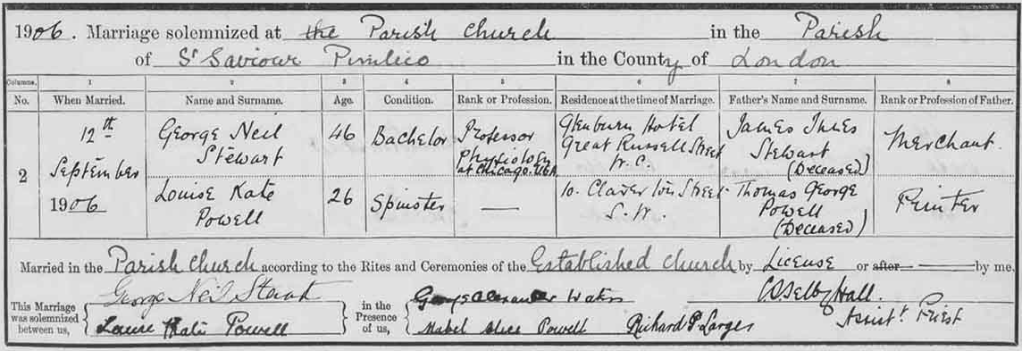
On 12th of September, 1906, George Neil Stewart married Katherine Louise Powell at Saint Saviour’s Church, Pimlico, London.
Who was she ?
KLP was born into circumstances more straightened than GNS’s.
We find it hard to understand poverty, until experienced firsthand, particularly at a level where it locked people into their neighborhood, attitudes and possibilities. It happens here and now, but we may choose not to notice it. More than the lack of money, being poor radicalizes those who experience it, though few acquire the means and ability to realize or express their conversion. Sensible people will do amazing things to escape the threat.
Despite the tremendous wealth and resources taken from Britain’s militarily subjugated colonies around the world, there was tremendous poverty and hardship at home in the British Isles. Low cost materials benefited the investor class, then the merchant class. Just as Parliament decreed that Indian farmers must grow cotton or indigo at the risk of starving, the home government also legislated poverty for a significant segment of their own lower class, to make them desperate for any employment in industry or army, a ready pool to serve the masters. The ultimate colonial system modeled on slavery and free resources.
Holding down earnings for the working class, limiting access to opportunities, meant wages might cover food and lodging, with little left over for rainy days. Many didn’t have the means to move from one area of London to another. Did they imprison themselves ? How many stayed when any alternative was offered ?
Aunt Kitty from New York City mentioned that she, on tour with a theater company after WW2, visited her mother’s sister in London. That small lead, that one Powell sister was still alive, made records easier to find. Their mother, Sarah Powell, listed herself in the 1891 census as a widow with 2 daughters, Katherine Louise, 11, and Mabel Alice, 8. Apart from that one entry, I haven’t found any records for her husband, Thomas Powell, the printer, their marriage, his age, business or death.
Over a few decades, Sarah proved herself a determined single mom. By working as a domestic maid in a big house, then bar maid, and whatever other work she found, she managed to keep her daughters. Women’s work paid less and long hours weren’t great for parenting. The risk of losing one job hovered close. At age 10, KLP left school. The reason was written on the school register; she wasn’t attending classes. A 10 year old girl’s income, though meager, covered some costs.
Women were undervalued in the imperial system and their side of events were under-represented in all levels of society and politics. The well-off might chuckle over fibs about declining morals of the poor, their inability to focus, stupidity, living day-to-day with no thought for the future. Their deliberate ignorance belied their part in creating squalor and allowed the lower classes some freedom from their attention. People showed remarkable inventive ways to overcome disadvantages.
Before machines were marketed for housework, well-off houses needed servants to do the laundry, cooking, cleaning and washing. In a middle class home, of a physician for example, the wife needed at least a cook and two maids to run the household, feed their sons and daughters, and clean the house. Poor women were offered these jobs at the expense of neglecting their own lives, homes and children. They were the hands to fill the tub, wash clothes, clean floors with broom and rag, cook for breakfast lunch supper and shop for food. Many servants were contracted to live in and be available at any time.
The upper classes demanded many more servants to coddle themselves, their children, and guests in their large inheritances. Schools started to train young women how to empty bed pans, wash linens, cook and serve the well funded. Graduation was rewarded with 5 years’ indenture at low wages, an exploitation helpful for toffs but not the servant.
As most people would, servants saved their pay and looked for better openings. This trickle down drove the demand to train replacements. In movies, the crusty uppers complained how hard it was to find a good servant. Servants knew how hard it is to find a decent employer.
Servant recruitment companies grew desperate enough that they turned to orphanages and bonded children into contracts paying so little that indentures became another form of poverty. If the schools or families had paid more or treated better, they might have solved the shortage. The orphans lost their childhood and fair compensation.
On the following census, 10 years later, KLP is listed as servant in a large house employing 20 inside. Is this where she first met GNS ? Did she quip to draw his attention ? Was she a sassy maid ?
Or did she apply to a matrimonial company which matched young eligible women of good character to men of sufficient income ? Companies supplied the overseas requests for wives from the home country. In effect mail order brides, arranged marriages with all the hazards of fulfilling a legal bond, or breaching it because of incompatibility. Some people don’t take into account different expectations and preferences. That conflict we might better understand. Who is Richard P. Larges, Garys Alexander Watiss, who signed as witnesses ? Would a matrimonial agency send witnesses to confirm that the betrothed honored their contract ?
Which brings up the question of why GNS didn’t look for a wife in his adopted city, Cleveland. He had taught and lectured at universities in Boston and Chicago as well, but he didn’t court for a wife there.
 Tracking my grandparents and famiIies